


How Closures Work and Why It Matters
They might sound complicated, but they are actually a fundamental part of the language. In this article, we’ll explore closures in a straightforward and practical way. Let’s clear up common misunde…

I’m Aleksei, a Forward Deployed Engineer with 12+ years in the JavaScript ecosystem across financial services, banking, and retail. I design AI solutions on TypeScript, Node.js, and React, take them to production, and leave behind the standards and tooling that keep them running. Claude Certified Architect – Professional.
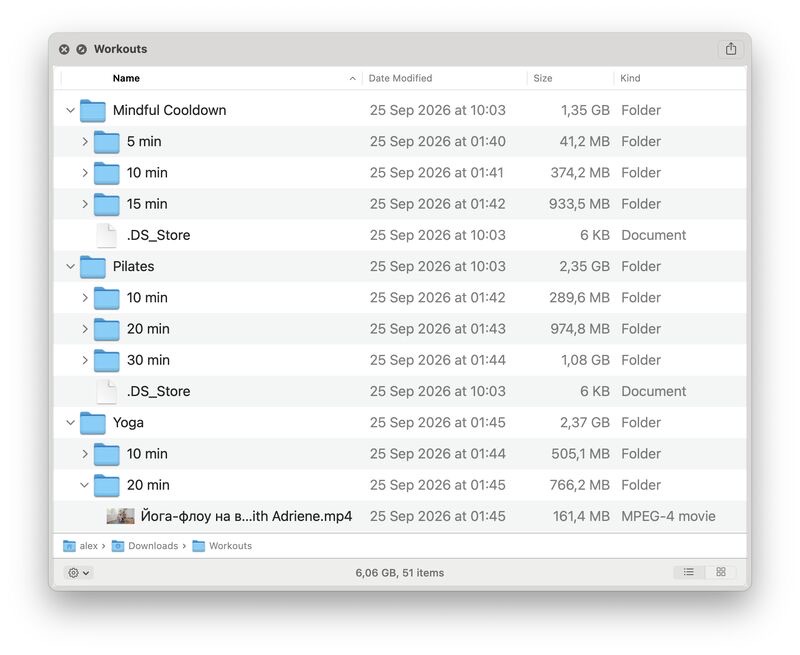
Another $79.99/yr back from Apple thanks to AI Fitness± style workouts, offline on my iPad Pro I build agentic workflows for some of the world's largest companies at Luxoft Serbia. This one curates my mat. The result: a local library laid out like Fitness±. Pilates and Yoga, Mindful Cooldown. Sourced from 14 hand-picked YouTube channels. ⚪️ Filters: mat only, voice-guided, up to 1440p ⚪️ Judge: Claude reads each transcript and scores it against a "feels like Fitness±" rubric ⚪️ Cleanup: SponsorBlock cuts sponsors and "like & subscribe" ⚪️ Variety: 120 fps, HDR, raw files ready. Claude Code wrote the tool. Opus picks the workouts overnight. On the mat, it's plain mp4: no AI, no network. No monthly fee.
Read on LinkedIn: post from September 27, 2026
AI saves me $239/yr on offline lossless music in my pocket I build agentic workflows for some of the world's largest companies at DXC Technology. So I used AI to bring my tracks back to me. The result: a local tool that converts my FLAC collection to ALAC and makes Apple Music look like the subscription: ⚪️ Lyrics: community library LRCLIB ⚪️ Artwork: iTunes Search API and Cover Art Archive ⚪️ Metadata and composers: MusicBrainz API ⚪️ Tempo, key and playlists: computed locally with librosa (Python) Every API is free. No keys, no registration. No AI at runtime either: AI built the tool, the tool runs without it. Build once, forget. Files I own, in my pocket: 24-bit/96 kHz ALAC, up to 3,207 kbps. No monthly fee.
Read on LinkedIn: post from September 27, 2026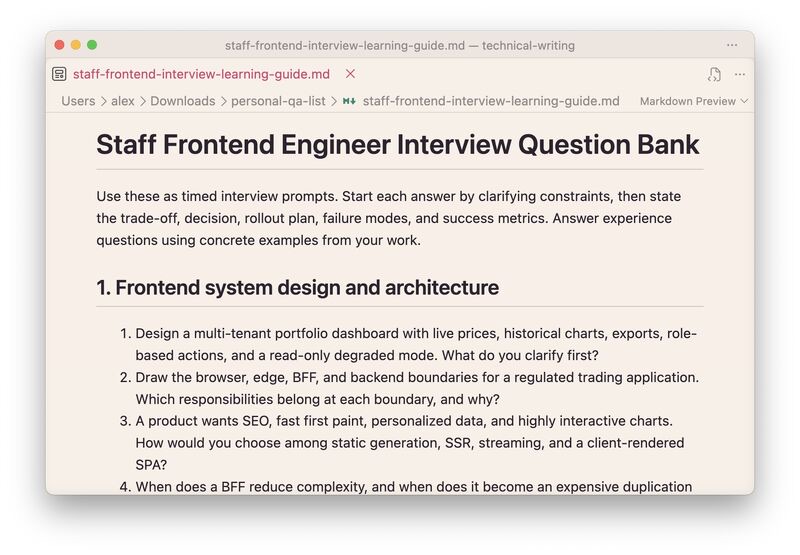
"Top 100 frontend interview questions" lists have one flaw. They're written for everyone. Not for your gaps. At Luxoft Serbia (part of DXC Technology) I build AI agent workflows for customers. This time I pointed one at my own CV, aiming at Staff Frontend interviews in 2027. The pipeline: 1️⃣ The agent reads my CV and lists likely gaps for that role. 2️⃣ It ranks skills and keeps the top 10. 3️⃣ Per skill: 3 most-viewed YouTube videos + 3 newer ones. 60 total. 4️⃣ yt-dlp pulls the audio, MacWhisper transcribes it locally. 5️⃣ The agent turns transcripts into questions, then checks every citation. Key rule: no downloads until I approved the plan and its definitions of "popular" and "growing". Result: 100 questions in 10 minutes. Questions only. Answering them is the prep. Example: "An agent produces plausible code that passes unit tests but violates an architectural boundary. How should your workflow detect this?" Want the full bank? Send me a connection request with "QA" in the message.
Read on LinkedIn: post from September 27, 2026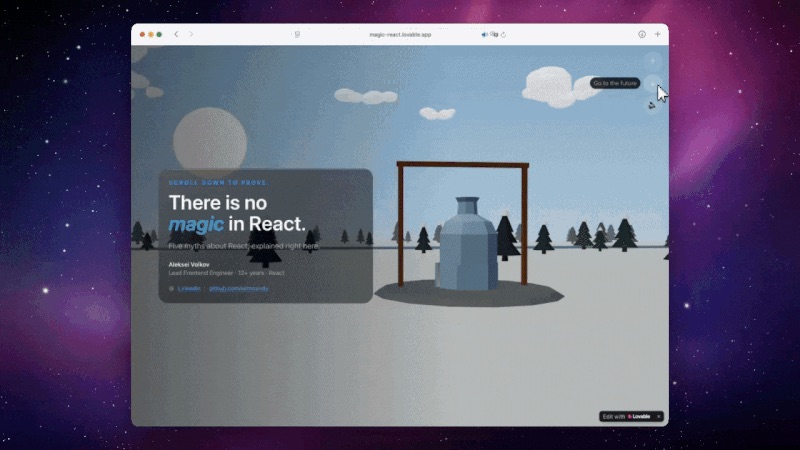
"I build websites with a single prompt." Well... almost true with Lovable. The prompt was one. But how much went into writing it? 1️⃣ Idea. Four React interview questions I actually ask, and most candidates don't understand the concepts behind them. 2️⃣ Prompt. `min(46ch, 52%)` is coding, not prompting. An LLM is way better than you at the specifics, so let it do its work. Just drive it. 3️⃣ Plan. Plan mode first. Lovable's own docs say the biggest failure mode is prompting too early and prompting whole pages. 4️⃣ Testing. The prompt got polished across dozens of question-and-answer rounds, Playwright runs, and library choices. Those four steps are the single prompt. The result: https://lnkd.in/djtuUfcN
Read on LinkedIn: post from September 13, 2026I spent years polishing my GitHub. Three things changed my mind. When I started interviewing candidates at a corporation where interviewer and candidate can sit in up to seven different countries. 1️⃣ Company names that impress locally mean nothing across borders. Not Oracle or FAANG? I don't google to verify you. 2️⃣ Years of experience stopped being a signal. A year in, strong engineers with rough resumes and weak candidates with polished ones show up equally often. 3️⃣ Security policy blocks me from opening a candidate's GitHub or LinkedIn during interviews. Regular training, no exceptions. My unproven opinion: GitHub's hiring value is close to zero. A working link is enough — nobody on my side ever opens it. Not a call to abandon GitHub. Just a reason to stop spending scarce prep time polishing something a technical interviewer structurally can't see.
Read on LinkedIn: post from August 16, 2026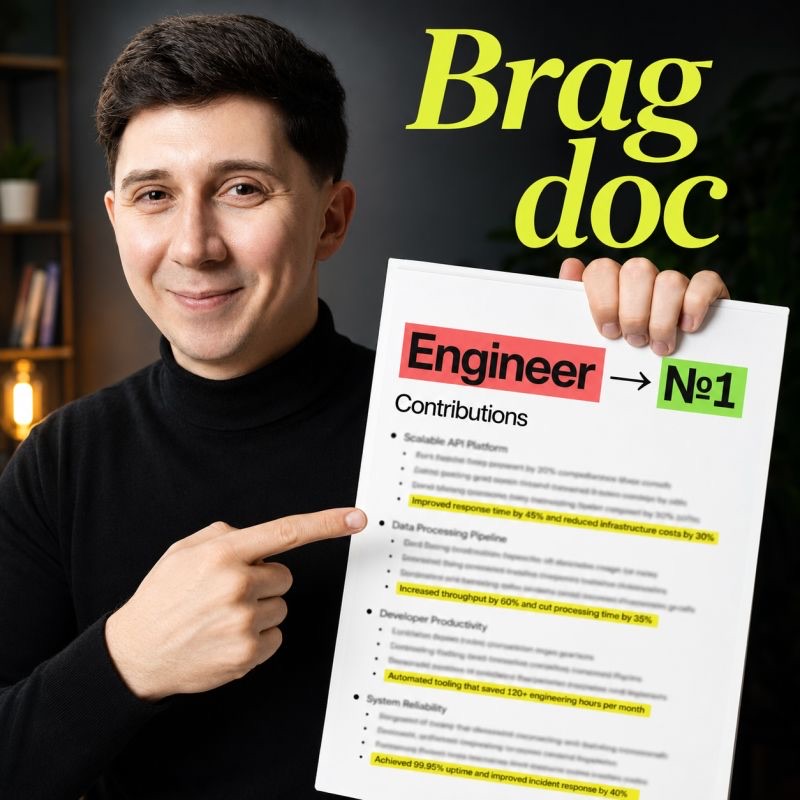
Your company is №1 in its market. Check the landing page — it says so. Where are you №1? Commitment #2 by 2030: an automated brag document. The idea comes from Julia Evans: https://lnkd.in/dX2HfJKe. Every company knows its positioning — a whole PR department works on it. My company can tell any customer exactly why it wins. But me, the engineer behind that work? I couldn't name my own killer feature. So, the pipeline: 1️⃣ filter the project's git history by your name; 2️⃣ summarize it with AI; 3️⃣ group by project. That's a record of progress. Performance review in two weeks? Ready now. Stuck on your GitHub bio? You have highlights. Extend the output formats — CV, cover letter, personal landing page — and you're №1 in the market of "you". Tools already exist: https://lnkd.in/dzJh-bN4, or paid: https://bragjournal.ai. By 2030: a brag document that updates itself — not the night before a review. Commitment #3 is coming.
Read on LinkedIn: post from July 20, 2026
Your company hired you through an ATS. Why don't you have one? Last post I promised my 2030 commitments. Here's the first: track the job market. Locally. Ashby and Greenhouse charge companies thousands to write job descriptions, source candidates, parse and list them. Companies hire every day — that's how they feel the market's pulse. At my company, our values are Get It Done, Never Settle, Think Deeper. Hard to "never settle" when my only market signal is the annual performance review. A candidate-side ATS answers what I actually care about: 1️⃣ how companies expect AI to be used; 2️⃣ which professions of tomorrow are already visible; 3️⃣ what engineers with the same 40-hour week do to compete with me. My starting point: https://lnkd.in/dkwTmbDf. I run my own fork — the original is over-engineered for one person, but it's the best candidate ATS I've found. By 2030: a stable workflow with monthly reports on jobs, companies, requirements, and personal insights. Next commitments are coming.
Read on LinkedIn: post from July 19, 2026
Apple will be carbon neutral by 2030. Zara too. What's your 2030 commitment? At Luxoft Serbia (part of DXC Technology), I ship against real customer deadlines every sprint. Nobody accepts "the market is down" as an excuse for a missed release. Why does it work on LinkedIn? Open Apple's quarterly report and you won't find "competitors are cheating with AI" either. Just a target, a plan, a number, a date. Scroll LinkedIn for five minutes and you get the opposite: complaints about the market, competitors, AI ruining hiring. Excuses dressed up as insight. A free market exists so you stand out from competitors, not blame them. LinkedIn exists to link people — share ideas, projects, strategies — not vent. Call me old-fashioned — I'm here for connections and stories, not complaints. That's why my Featured section holds only educational projects — I built a framework from scratch to prove I understood how one works. A commitment I can point to, not an excuse. Here's mine for 2030: I'll share it in my next post. What's yours?
Read on LinkedIn: post from July 12, 2026
"How to center a <div>?" For years that was a real interview question. Now AI gives you seven correct answers in two seconds. So does asking it still tell me anything about the developer sitting in front of me? At DXC Technology (Luxoft) I interview engineers and onboard them into AI-heavy workflows. The line I watch for has moved. It used to be "knows the syntax / doesn't." AI closed that gap for everyone. The new line is "can ask the right question / can't." Think of AI as a book of every recipe on earth. It describes any dish better than a star chef. It still won't tell you how these recipes were made and how to create a new one. So that's the question I actually care about now: out of seven correct answers, which one, and why? What's the last thing AI answered perfectly — that you only got right because you knew what to ask?
Read on LinkedIn: post from July 1, 2026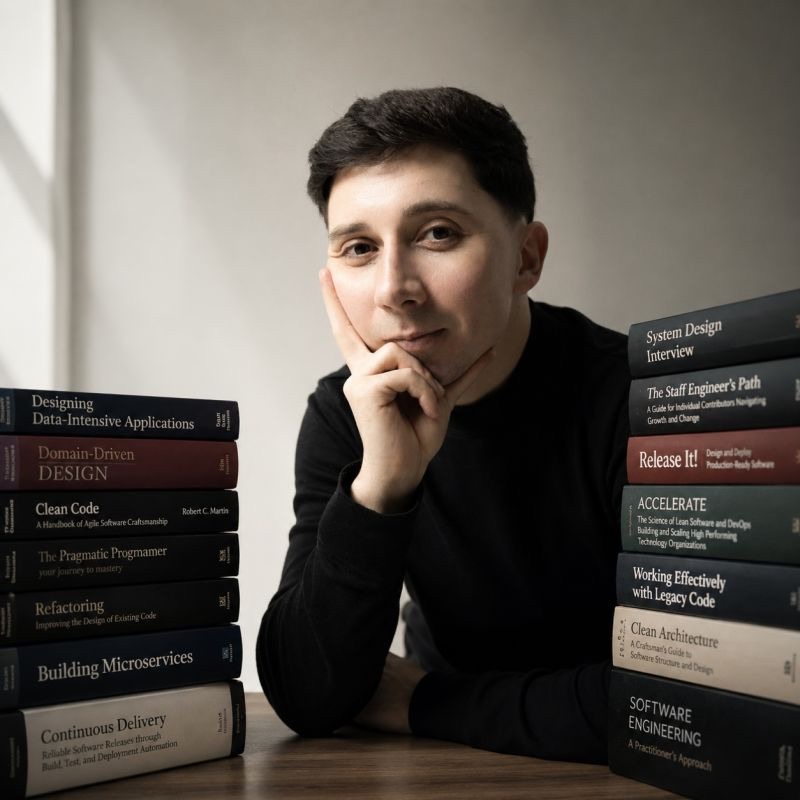
2 books cover 99% of React interview questions. I built my own framework... While preparing to run technical interviews at DXC Technology. The goal was simple: stop giving surface-level answers and actually understand what I was asking candidates about. I wanted real answers to three questions: - Why does React exist? What problem does it solve? - How can React, written in TypeScript, render faster than plain TypeScript? - What does "render" actually mean — in the browser, and inside React? I tried digging through React source with an AI agent. It worked. It also burned an absurd amount of time. Hundreds of engineers could explain this clearly, but almost nobody does it publicly. Then I found two books that closed the gap. "Build a Frontend Web Framework (From Scratch)" by Angel Sola Orbaiceta. The missing bridge between internet takes like "React is faster than JavaScript" and the actual source. The method: build the standard solution first, then re-architect it. Every React concept lands because you felt the pain it solves. "Micro State Management with React Hooks" by Daishi Kato — author of Zustand, Jotai, Valtio, and Waku. Quietly dismantles the "Redux just stores state better" myth. There is nothing else like it. What titles changed how you think about your craft?
Read on LinkedIn: post from May 27, 2026They might sound complicated, but they are actually a fundamental part of the language. In this article, we’ll explore closures in a straightforward and practical way. Let’s clear up common misunde…
Hello, fellow front-end developers! Imagine a tool that’s not about punching in commands but a gateway to a world of coding artistry. That’s what the macOS Terminal became for me at Luxoft.
Ready to make your digital life bulletproof like a Siberian bunker? Check out our latest step-by-step guide on backing up your entire MacBook, fortified with Russian-hacker-approved methods! From activating iCloud's Advanced Data Protection to open-source alternatives that make you untouchable, we cover it all.